Highly coupled links
Transport, warehousing, ports, rail, and fleets affect each other, and point optimization is hard to propagate globally.
For energy, mining, manufacturing, ports, multimodal transport, and large supply-chain enterprises, make every dispatch decision closer to an optimal answer.
Book a ConsultationIn complex logistics scenarios, transport, warehousing, ports, rail, and fleets are tightly coupled. Dispatch must consider weather, congestion, equipment, people, environmental constraints, and changing customer demand at the same time. Traditional rule-based systems and manual experience struggle to reach a global optimum.
Transport, warehousing, ports, rail, and fleets affect each other, and point optimization is hard to propagate globally.
Weather, congestion, equipment, people, and environmental constraints interact simultaneously, making dispatch constraints complex and variable.
Customer needs and plans change frequently, causing prior plans to expire quickly and resources to be hard to match in time.
Traditional rule-based systems and manual experience cannot cover all scenarios, making global optimization difficult to achieve.

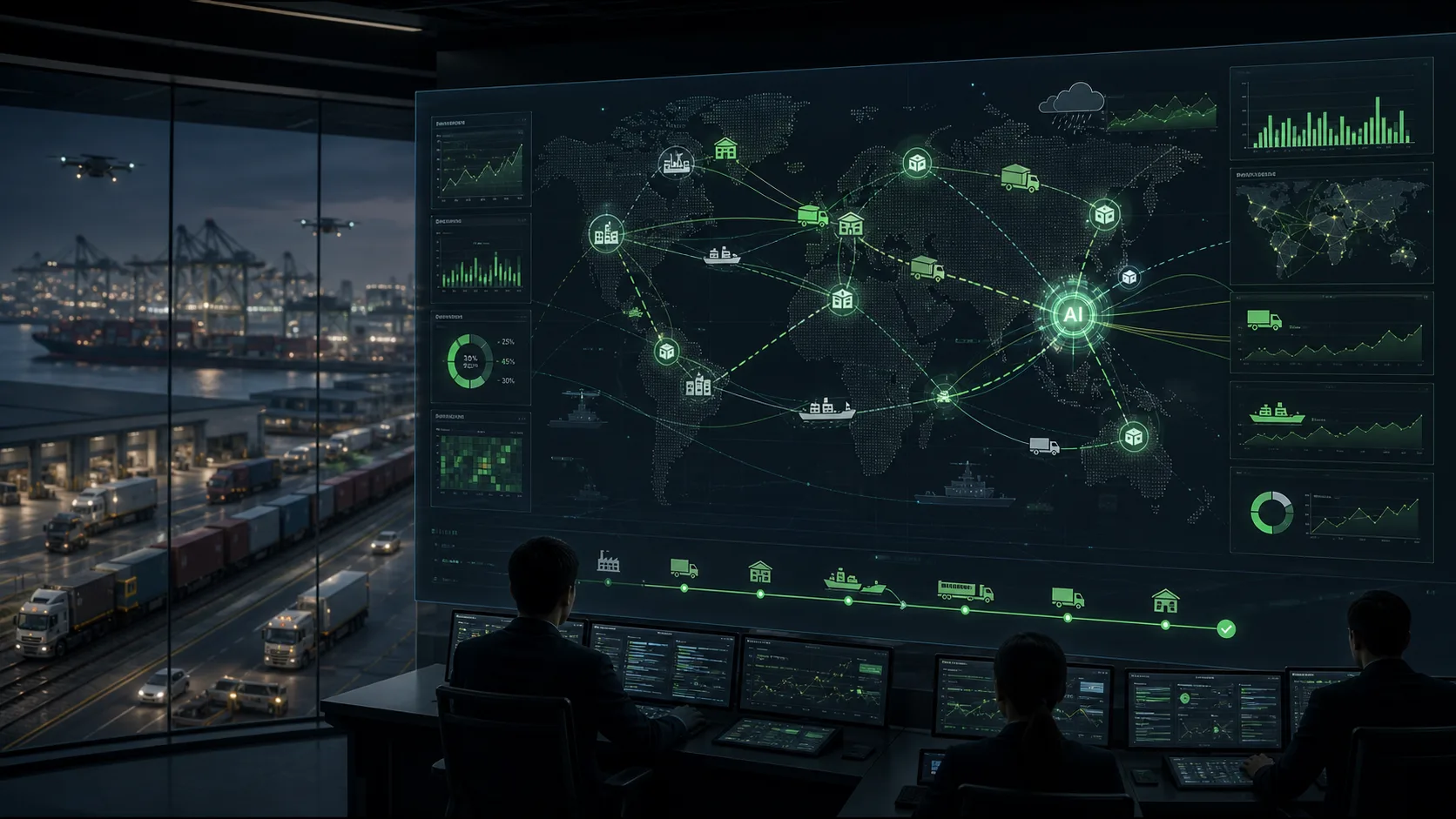
Based on enterprise multi-agent capabilities and logistics ontology, connect order, capacity, inventory, route, port, equipment, and cost data to build a real-time business fact base. Dynamically identify anomaly signals, call tools such as operations research optimization and prediction models, and generate solution simulations and decision recommendations.
Help enterprises upgrade from point dispatch tools to a Logistics AI Decision Hub, improving resource allocation, accelerating disruption response, and continuously codifying reusable industry models and dispatch experience.
Connect transport, warehousing, ports, rail, and fleets to improve resource allocation.
Identify anomaly signals in real time and automatically trigger recalculation, shortening the time from detection to execution.
Reduce waiting and idle time to improve overall throughput and fulfillment efficiency.
Codify reusable industry models and dispatch experience to continuously optimize decision capability.